

Current Location : HomeProductsEfficient air filterManufacturer of ultra-low resistance, plateless, high-efficiency air filters
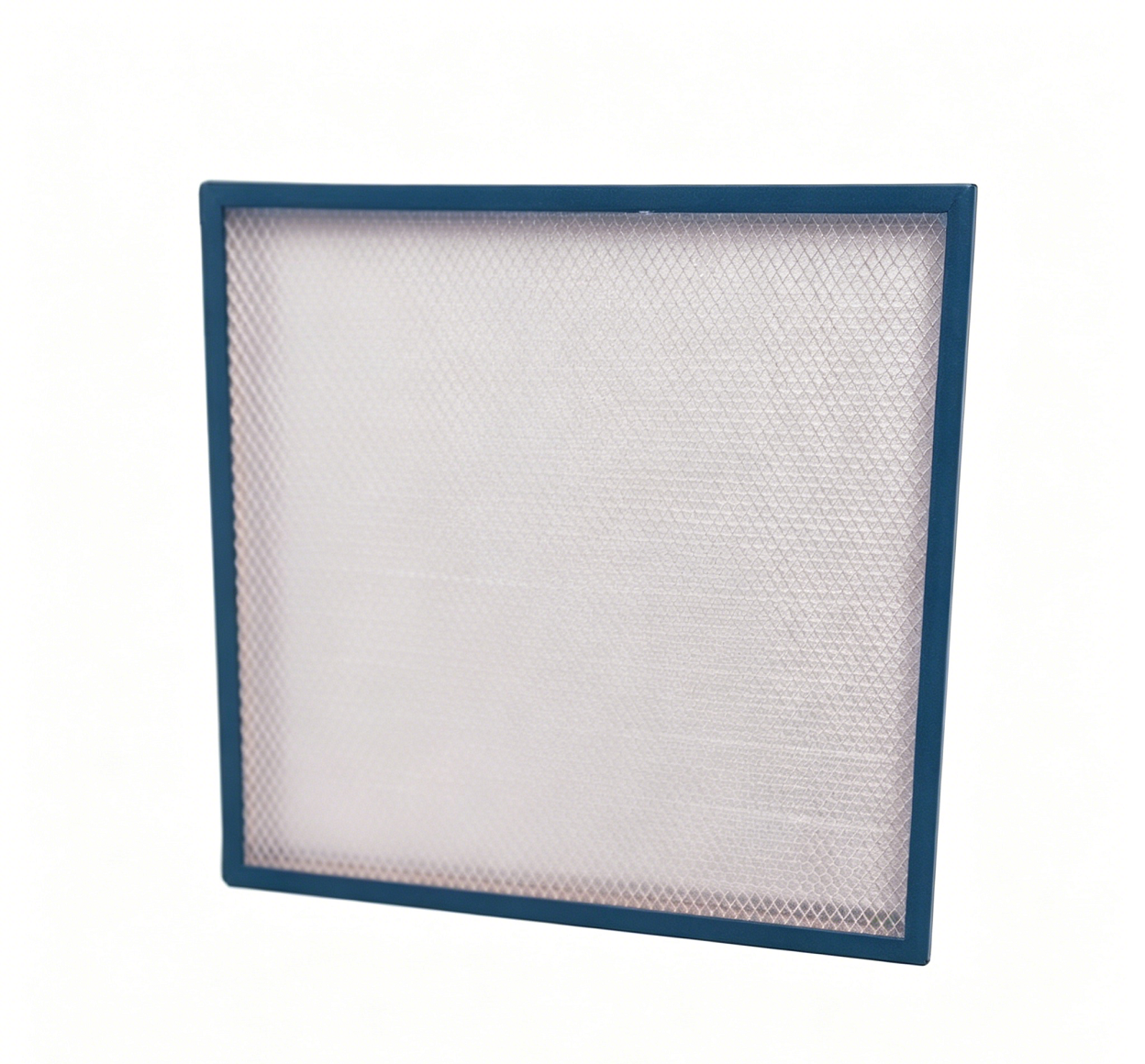
Manufacturers of ultra-low resistance, plateless, high-efficiency airflow devices: Dust particles in the air move with the airflow through inertial motion, random Brownian motion, or under the action of a certain field force. When the particles collide with other objects, the van der Waals forces (forces between molecules and molecular clusters) between the objects cause the particles to stick to the fiber surface.
Manufacturer of Ultra-Low Resistance, Plateless, High-Efficiency Air Filters
Airborne dust particles move due to inertial motion, random Brownian motion, or the influence of some field force. When these particles collide with other objects, the van der Waals forces (forces between molecules and molecular clusters) cause them to adhere to the fiber surface. Dust entering the filter medium has more opportunities to collide with it, and upon impact, it becomes stuck. Smaller dust particles collide and agglomerate to form larger particles that settle, resulting in a relatively stable concentration of dust particles in the air. This is why indoor surfaces and walls fade.
It is a misconception to view fiber filters like sieves.
Inertia and Diffusion
Particulate dust undergoes inertial motion in the airflow. When it encounters randomly arranged fibers, the airflow changes direction, and the particles, due to inertia, deviate from their original direction and collide with the fibers, becoming stuck. Larger particles are more likely to collide, resulting in better filtration.
Small dust particles undergo random Brownian motion. The smaller the particles, the more intense the random motion, the more opportunities they have to collide with obstacles, and the better the filtration effect. Particles smaller than 0.1 micrometers in the air primarily undergo Brownian motion;
their small size results in good filtration. Particles larger than 0.3 micrometers primarily undergo inertial motion; larger particles have higher efficiency. Particles with little diffusion or inertia are difficult to filter. When measuring the performance of high-efficiency filters, the efficiency value for difficult-to-measure dust particles is often specified.
Ultra-low resistance, plateless, high-efficiency airflow filter manufacturer
Electrostatic Effect
Due to various reasons, fibers and particles may become charged, generating an electrostatic effect. Electrostatically charged filter materials can significantly improve filtration performance.
Reason: Static electricity causes dust particles to change their trajectory and collide with obstacles; static electricity also makes dust particles adhere more firmly to the medium.
Materials that can generate static electricity are also called "electret" materials. Even with static electricity, the resistance of the material remains unchanged, and the filtration effect is significantly improved.
Static electricity does not play a decisive role in filtration effectiveness, but only an auxiliary one.

We use cookies to enhance your browsing experience, deliver personalized content, and analyze website performance. Strictly necessary cookies are essential for the proper functioning of the website and cannot be disabled. You may choose to enable or disable analytical cookies, but disabling certain cookies may affect some features or your overall browsing experience. You can manage your cookie preferences below. For detailed information, please refer to our Privacy and Protection Policy.
If you have any comments, suggestions, or questions regarding our use of cookies or this Privacy Policy, or if you wish to make a request or inquiry concerning your personal information, please contact us at 1622018819@qq.com
 English
 Italiano
 Français
 Deutsch
 Русский язык